AI gym management software: run your fitness business by asking, not clicking
Why AI productivity is the real advantage
Most fitness software still runs the same way: you learn where every setting lives, click through screen after screen, and export data into a spreadsheet before it means anything. For an owner who is coaching, covering the front desk, chasing payments, and trying to grow all at once, that is time you do not have.
AI-native software changes the starting point. Instead of learning the software, you talk to it. 1club is built AI-native from the ground up, so intelligence is woven through your live member, booking, and billing data rather than bolted on afterward. The result is not a feature you visit now and then. It is a faster way to run the whole business.
Here is what sets 1club AI Connect apart from a chatbot sitting inside your software. You bring your own assistant. ChatGPT and Claude are always on the latest, most capable models, and they connect straight to your live 1club data through a secure connection, so the answers reflect what is actually happening in your business this week. Some platforms box their AI inside their own product, limited to whatever model the vendor ships. 1club is open by design. Your AI, your data, your tools.
From a question to a decision, in four steps
The clearest way to see the productivity gain is to follow one thread every owner cares about: keeping members. Watch how a single plain-language conversation moves from a quick lookup to a real plan of action. Take a Brazilian jiu-jitsu academy as an example.
Quick actions. Get the number now.
You start with a simple question, the kind you would normally dig through reports to answer:
- Who hasn't checked in over the last 10 days?
- How many active members do I have right now?
- What no-shows and late cancels happened yesterday?
- Which classes are packed, and which are nearly empty this week?
No dashboard to configure, no export to clean up. You ask, you get the list.
Insights. Connect the dots you did not have time to.
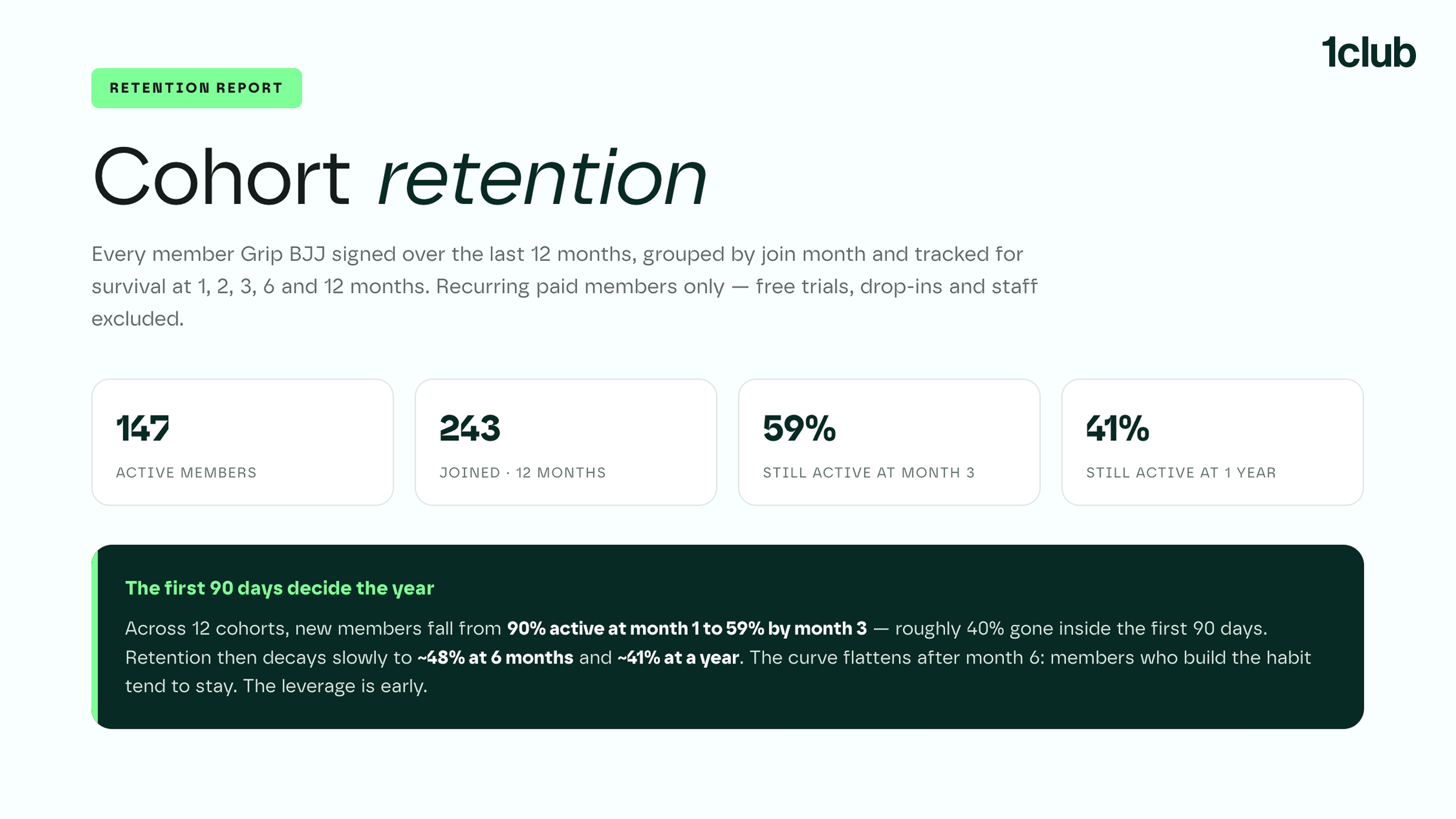
Now go a layer deeper. Of the members who have gone quiet, which are also behind on payment or have a cancellation coming up? That one follow-up turns a flat list into a picture of who is genuinely at risk. And the output is not a line in a chat window. Ask your assistant to chart how many new members are still training at 1, 3, 6, and 12 months, and it builds a full cohort retention report from your live data.

In this sample report from our demo account, 90% of new members are active at month one, but only 59% by month three. That is roughly 40% lost inside the first 90 days, then a slow decline to 48% at six months and 41% at a year. The steepest fall sits between day 30 and day 90, the point most academies consider a member "stuck." Seeing that cliff in one chart tells you exactly where to focus.
A sample cohort retention report, generated by asking an AI assistant through 1club AI Connect. See the full report. Figures are illustrative.
Decisions. Turn the picture into a shortlist.
An insight only helps if it tells you what to do next, so you ask the assistant to make the call:
- Which members are most likely to cancel in the next two weeks? Rank them, and draft a check-in message for each.
- Of the at-risk members, who should I reach out to first?
- Which leads should I follow up with first? Draft the first message.
You go from "retention is slipping" to a ranked shortlist and ready-to-send drafts, without opening a spreadsheet.
Strategy. Ask the bigger question.
Once you can see the pattern, you can act on the cause, not the symptom:
- What can I do to improve retention in the first three months?
- How should I reshape my schedule around when people actually show up?
- Which number should I be worried about right now?
Because the assistant reasons over your real data, the advice is specific to your business. That 90-day cliff becomes a plan: a stronger first-month experience, timely check-ins, and a schedule that matches when your members actually train. Retention is just one thread. The same four steps work for filling classes, converting leads, and tightening cash flow.
Analyst-grade reports, on demand
The retention curve above is one of a whole set of reports you can pull just by asking. Each reads your live data and comes back as a clean, shareable document:
- Retention and churn overview. Your headline numbers, with voluntary cancellations separated from involuntary lapses caused by a failed payment.
- Cohort retention curve. Where new members drop off, month by month, so you know where to intervene.
- At-risk members. A ranked list scored on attendance trends, days since last visit, recent no-shows, and payment status, with a suggested action for each.
- New member activation. How your first 90 days are performing, and which recent joiners have stalled and need a nudge.
- Lifetime value and tenure. What a member is worth and how long they stay, broken down by plan, so you can see which segments are the stickiest.
No reporting module to learn. Your assistant does the analysis and hands you something you can share with a partner or your team.
Built for your kind of fitness business
The questions change with the room. Because AI Connect works from your live data, the same conversation adapts to how you actually operate.
Gyms and fitness studios
Keep classes full and cash flow steady. Ask which sessions are packed and which are half empty this week, where this month's revenue is coming from, or how many active members you have right now, then let your assistant draft the follow-ups. See gym management software.
Martial arts academies
Front-loaded white-belt drop-off is the retention story in most academies, exactly the pattern in the report above. Ask which students have been at their current belt for more than eight months, who hasn't checked in over the last 10 days, or which recent joiners are slipping before the 90-day mark. Belt and progression tracking lives in the platform, so your assistant can reason over it. See martial arts software.
Yoga and Pilates studios
Class packs and instructor load are the levers. Ask which reformer classes are nearly full and which have open spots this week, who bought a class pack two months ago but hasn't rebooked, or how booked each instructor is, then reshape the timetable around real demand. See yoga studio software and Pilates studio software.
Racket clubs: tennis and padel
Courts and events are your inventory. Ask how booked the courts are this weekend, which members haven't played in three weeks, or whether Saturday's round-robin is on track to fill, and adjust before the gaps cost you. See tennis club software and padel club software.
From insight to action, in one conversation
AI Connect does not stop at answers. Through the same conversation, your assistant can take action across the platform when you want it to:
- Scheduling and operations: create, update, and cancel classes, manage rosters and waitlists, block or reopen courts and spaces, and record check-ins.
- Members and plans: create and update memberships, adjust plans, and resolve member and instructor details.
- Website and content: edit pages, navigation, and posts, then publish or roll back a draft.
- Products: search, reprice, and organize your catalog.
Access is read-only by default. Nothing changes unless you grant write access deliberately, one capability at a time, so the assistant only ever touches what you allow. Payments and billing stay in the 1club admin portal for now: your assistant can read the numbers behind revenue for insights, but money moves only where you expect it to.
Setup and switching, handled for you
The productivity starts before you have entered a single class. Moving from another platform usually means messy exports and manual cleanup. With 1club, you can drop in a spreadsheet and let your assistant structure it before import, or snap a photo of your paper schedule and have the skeleton built for you. Guided setup and migration keep you moving in real time, so you are up and running in days, not months.
Secure by design
Working directly with live business data means security has to be simple and strict:
- Owners and admins only. Connecting requires organization-management permission, so members never have access.
- Read-only until you say otherwise. Write access is granted capability by capability, and sensitive actions like publishing your website require their own permission.
- Short-lived, rotating access. Access tokens last one hour and refresh automatically, connections expire after 90 days of inactivity, only hashed credentials are stored, and you can revoke access instantly.
You connect in a few minutes with secure OAuth sign-in, or a Platform API key for developer-managed setups. Step-by-step guide: docs.1club.ai/mcp/connect.
Frequently Asked Questions
What is AI gym management software?
It is fitness business software with intelligence built into your live data, so you can ask questions and give instructions in plain language instead of clicking through menus. 1club is AI-native, and 1club AI Connect lets you use your own assistant, Claude or ChatGPT, to read your data, build reports, and make changes.
Can I use ChatGPT or Claude with my gym software?
Yes. 1club AI Connect connects your own assistant to your live 1club data through a secure connection. Owners and admins can set it up in a few minutes at docs.1club.ai/mcp/connect.
Is it safe to connect an AI assistant to my member data?
Access is owner and admin only, and read-only by default. Write access is granted one capability at a time; tokens are short-lived and rotate automatically; and you can revoke access instantly.
Which types of fitness business is it for?
Gyms and fitness studios, martial arts academies, yoga and Pilates studios, and racket clubs such as tennis and padel. Any fitness business running on 1club can connect.
How much does it cost?
AI Connect is included with the paid Run and Grow plans.

Martin is a go-to-market executive, fitness enthusiast, and competitive basketball player. He's built and scaled global revenue teams at B2B SaaS companies, growing organizations from early stage to $15M+ in revenue. A lifelong athlete, Martin stays active through CrossFit, gym training, basketball, and snowboarding. At 1club, he's leading the go-to-market strategy and execution.